


Adverse Weather, Degree Days and Your Electric Bill
From time to time, when talking about the weather’s impact (cold or hot) upon your electric bill, you may hear someone mention “degree days.” What is a degree day? And what do degree days have to do with your electric bill?
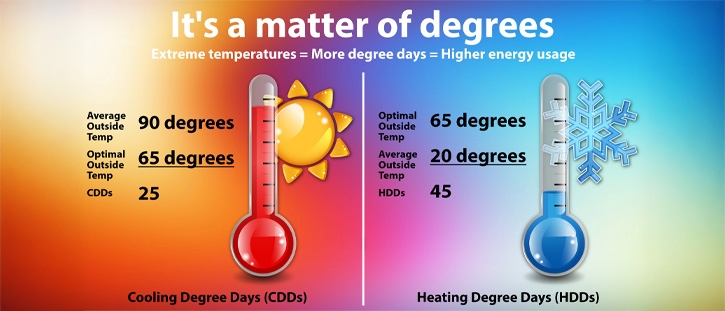
A degree day is a calculated measure of how cold or hot a location/place is on a given day. A degree day compares the average temperature (the average of the high and the low temperatures of a given day and location) to a standard temperature of 65 degrees. The difference (the deviation from the standard of 65 degrees) is a degree day, which measures the coldness or hotness for the day. Individual degree days can be sequentially added together and used to assess the weather conditions (coldness or warmness) for a period of days and weeks, and correlations can be made on an electric bill.
More specifically, there are heating degree days (HDDs) and cooling degree days (CDDs).
- HDDs are a measure of how cold the temperature was during a period of days. For example, a day with a mean temperature of 40 degrees has 25 HDDs. Two such cold days in a row have 50 HDDs for the two-day period.
- CDDs are a measure of how hot the temperature was during a period of days. A day with a mean temperature of 80 degrees has 15 CDDs. If the next day has a mean temperature of 83 degrees, it has 18 CDDs. The total CDDs for the two days is 33 CDDs.
In closing, there is a direct correlation between the daily fluctuations of the outdoor temperatures and your electric bill. Your electricity use for heating (if electric) and air conditioning rises with the number of degree days.
The more extreme the outside temperature (whether cold or hot), the cumulative degree days will be higher — resulting in higher energy use because heating and cooling equipment must work harder. If your bill shows higher usage in January (many HDDs) and July (many CDDs), degree days help explain why, as these periods require more energy to maintain comfortable indoor temperatures.
In essence, degree days quantify the weather’s impact, providing a standard measure of heating or cooling demand that directly influences your energy consumption and costs. For more information on degree days please visit eia.gov/energyexplained/units-and-calculators/degree-days.php.
